An agent that outlasts
every subscription.
An open-source agent that lives on your Mac, learns you, and keeps everything it learns on your disk. It never resets. It compounds.
Mac app, September 2026. Apple Silicon, universal binary. An iOS companion pairs to it and leaves the Brain at home.
henry-malcolm · the agent that builds Permagent · last reading, not currently reporting
16,451,602s
seconds at last contact
4,395
memories held on its own disk
Not a demo and not a marketing number. This is one real machine that has never been reset, read straight from its memory database.
What permagent is
One agent. Yours. Permanent.
Every cloud AI quietly becomes a diary of your life — chats, files, decisions, accumulating on someone else’s servers.
We think that is backwards. Permagent is one agent on your machine, with your keys, on any model. The code is open source, the data format is yours, and if we disappeared tomorrow your agent keeps working.
Every guarantee, itemizedThe modules
The whole system,
in thirty seconds.
Not a teaser list. “Shipped” means built and working in v1.31 — the app everyone gets in September.
Works with 12+ providers, including Anthropic, OpenAI, Ollama · local, llama.cpp · local, AWS Bedrock, Google Vertex, and fully local inference. Your keys, your account, no markup.
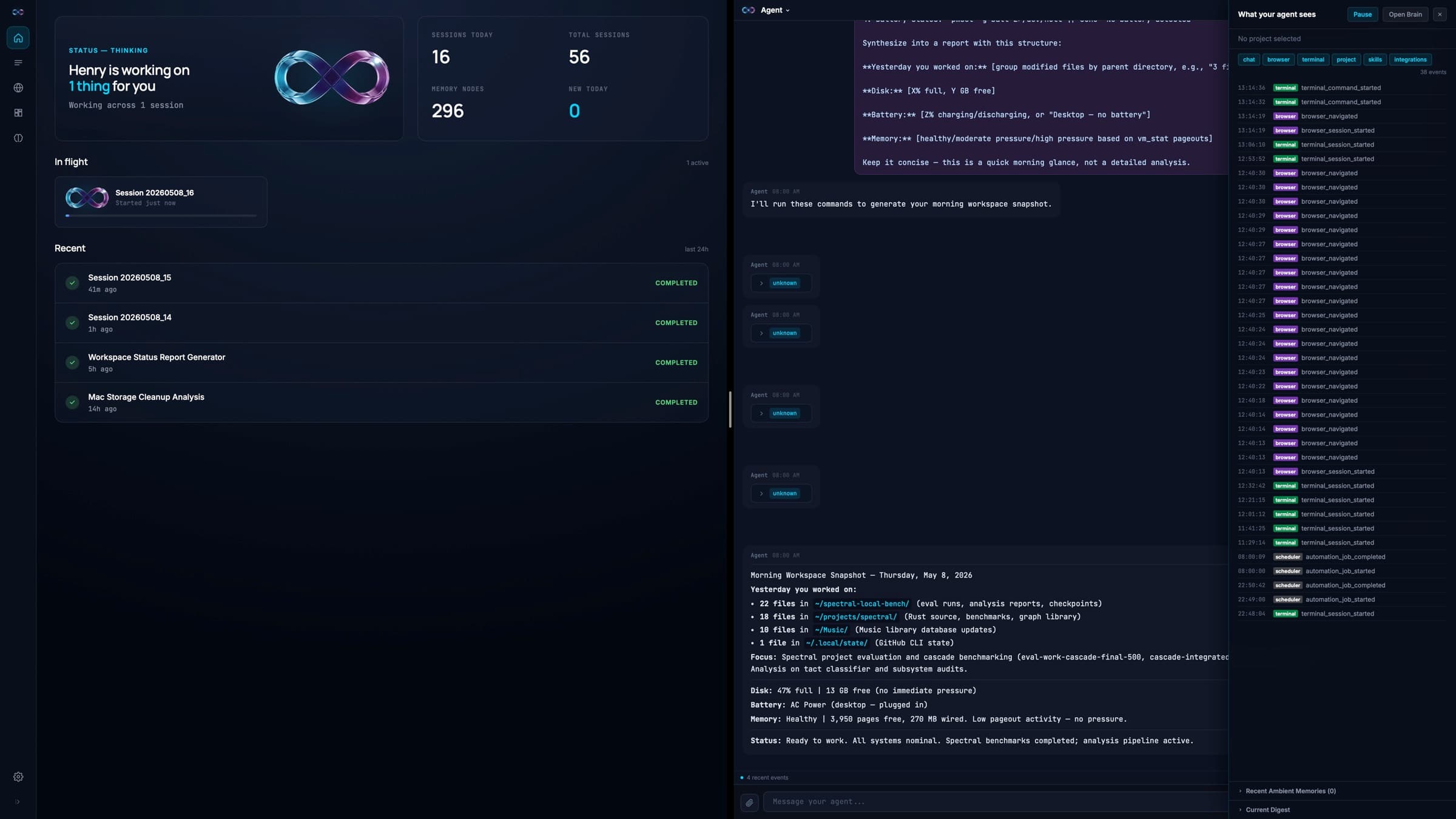
Inside the app
Not a chat wrapper.
An operating environment.
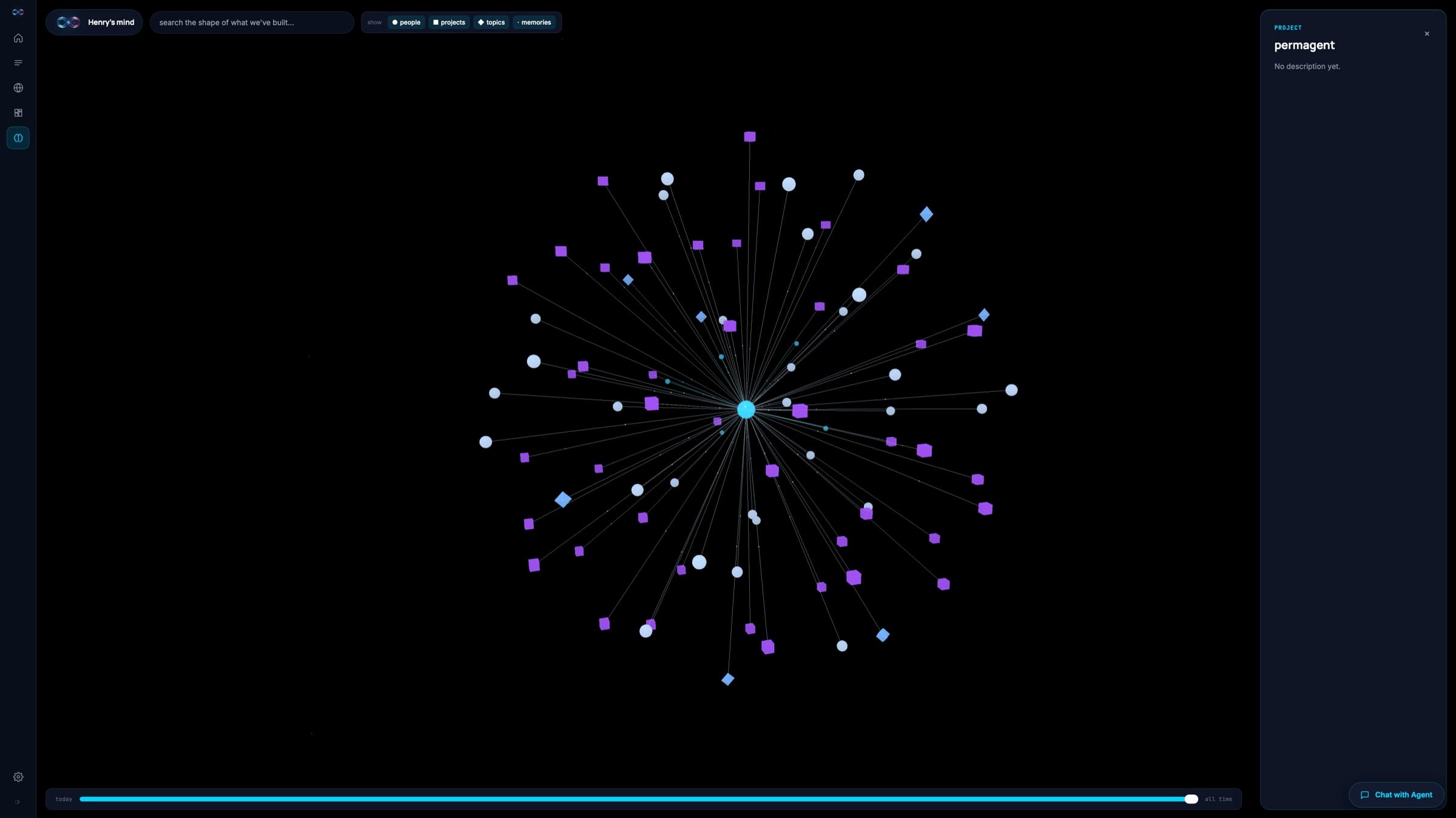
The Brain · Spectral
It never forgets.
Every conversation and decision lands in Spectral memory on your disk, and you can browse it live: a 3D memory graph and a list with entity filters and search.
LOOP_GUARD / INTERVENED
It cannot spin on the same mistake all night.
A monitor watches tool calls over a rolling window for the signatures of being stuck: the same call returning the same result, a failure retried unchanged, a check failing the same way, two actions oscillating.
EGRESS / REFUSED
In sovereign mode, nothing leaves. The call fails first.
The data boundary is fail-closed at the provider layer. Cloud inference is refused before any data leaves the machine, and only local models run.
COMMIT / BLOCKED
A secret cannot reach your git history.
Every file automated work commits is scanned for credential-shaped content first: env files, private keys, connection strings, tokens. The check is code, not judgement.
Spectral · the shared brain
One brain per agent today.
One brain per team tomorrow.
Spectral is Permagent’s open-source memory engine, designed for federation from the first commit.
Frequency-domain recall
Deterministic fingerprints instead of embeddings. Sub-millisecond, no GPU, no embedding bill.
A real knowledge graph
Typed entities and relationships with multi-hop traversal. How does X relate to Y is a query, not a vibe.
Primitives already in place
Ed25519 brain identity, per-fact provenance, and four visibility scopes ship in the engine today.
Many agents, one shared Brain
Everyone keeps an agent that learns them, federated into shared project memory no vendor holds. Working together is free.
The engine ships the primitives. The app writes Private today; scope controls, author stamping and member sync are the team-sync build.
The full team storyShipping in the open
The vision is long.
The releases are regular.
Every claim on this site is labeled shipped, engine-ready, or designed — and each build is logged as it lands. No vaporware sold as features.
The Mesh is the long game: verified agents sharing knowledge first, then pooling compute to run models no single machine could. The privacy design is published in full, and there is no Mesh code in the runtime yet. We will not pretend otherwise. The full Mesh plan →
v1.31
ships September
Team sync
next build
Knowledge Mesh
Q4 2026 beta
The Mesh
2027
Get it when it ships.
Join the waitlist to hear when the Mac app ships. If you want permanent standing in the record, Founding Senator seats are opening soon.